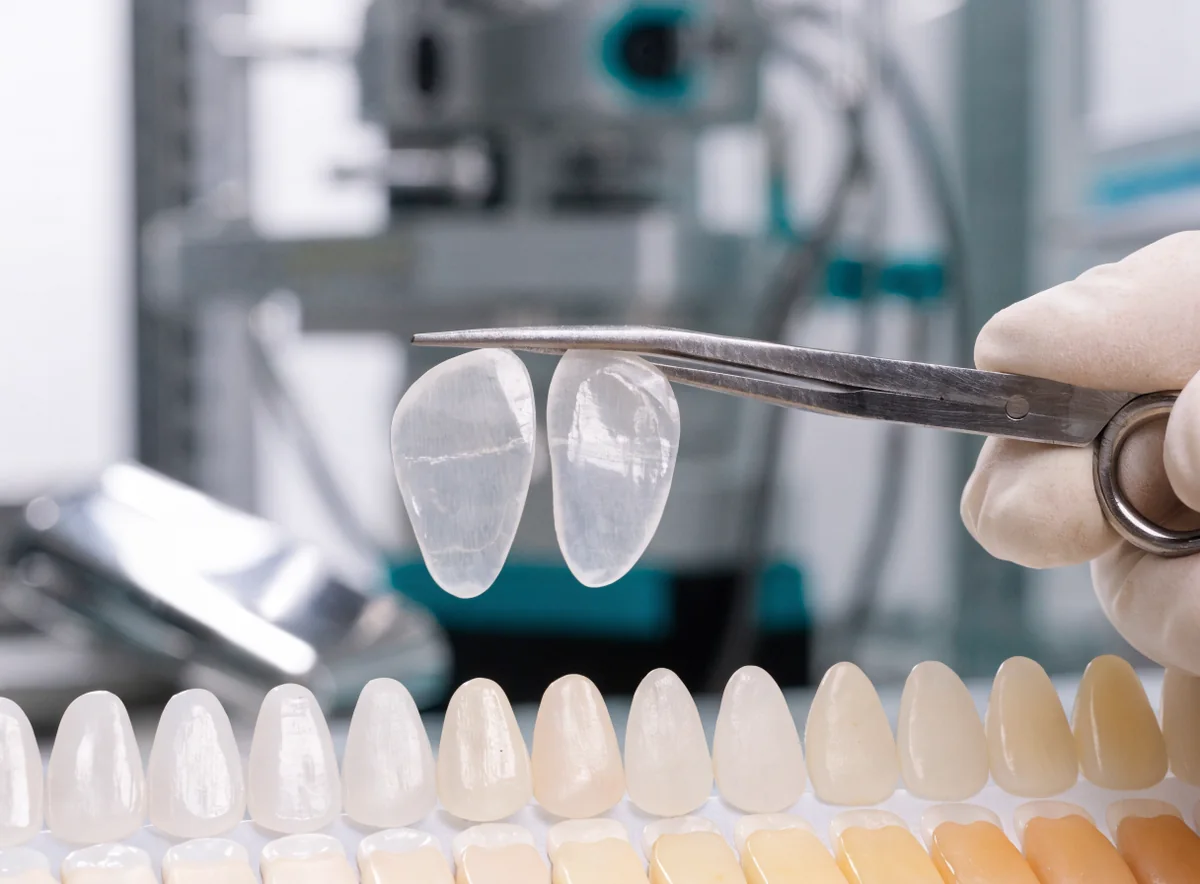
If you are researching a smile makeover, you have already met the two words that dominate every quote: veneers and crowns. Both can transform the colour, shape, and alignment of your teeth. Both are made from the same premium ceramics. Yet they are fundamentally different treatments, and the right choice depends far more on the condition of your teeth than on the result you want. Here is how the decision actually gets made.
The Core Difference: Coverage
A veneer is a thin ceramic shell — often just 0.3 to 0.7 millimetres — bonded to the front surface of a tooth. Only a small amount of enamel is polished away from the visible face; the back and sides of your tooth remain untouched.
A crown covers the entire tooth, all the way around, like a cap. The tooth is reshaped on all surfaces to make room for it. In exchange for removing more structure, a crown adds strength: it holds a weakened tooth together and shields it from chewing forces.
That trade-off — preservation versus protection — is the whole decision in one sentence.
When Veneers Are the Right Choice
Veneers are ideal when your teeth are fundamentally healthy and the goals are cosmetic:
- Discolouration that whitening cannot fix, including tetracycline staining
- Small chips, worn edges, or slightly irregular tooth shapes
- Gaps between front teeth that you want closed without braces
- Mild crowding or rotation, where veneers create the appearance of alignment
- A smile that simply looks tired and needs uniform shape and shade
Because veneers preserve most of your enamel, they keep future options open. The bonding between porcelain and enamel is also exceptionally strong — modern E-max veneers routinely last 10–15 years on well-selected teeth.
When Crowns Are the Right Choice
Crowns take over where veneers run out of tooth to bond to:
- Teeth with large fillings that have little healthy structure left
- Root-canal-treated teeth, which become brittle and need full protection
- Cracked, fractured, or heavily worn teeth
- Teeth that already have old crowns needing replacement
- Patients with heavy bites or grinding habits, where thin veneers risk chipping
- Back teeth, where chewing forces are highest and aesthetics matter less than strength
Modern zirconium and E-max crowns are nothing like the grey-margined caps of the past. On front teeth, a well-made crown is visually indistinguishable from a veneer — the difference is underneath, not on the surface.
What about durability?
Both restorations last well when properly made and maintained: roughly 10–15 years for porcelain veneers and 15 or more for zirconium crowns, with many lasting far longer. Failures usually trace back to grinding without a night guard, neglected gum health, or poor fit — not to the choice between veneer and crown itself.
Most Smile Makeovers Use Both
Here is what quotes often gloss over: a full smile makeover is rarely all-veneers or all-crowns. A typical plan might place veneers on six healthy upper front teeth, crowns on two premolars with old fillings, and a crown on a root-treated molar — each tooth getting the least invasive restoration that will actually last. A dentist who examines your X-rays and then prescribes tooth by tooth is planning properly. A clinic that quotes “20 crowns” before seeing a single scan is not.
Questions to Ask Before You Decide
- Which teeth are getting veneers, which are getting crowns, and why for each?
- How much of my natural tooth will be removed, and could a more conservative option work?
- What material will be used — E-max, layered zirconia, monolithic zirconia — and on which teeth?
- Will I see a digital design or mock-up before any preparation begins?
- Do I need a night guard afterwards, and is it included?
- What does the written guarantee cover, and for how long?
The Honest Answer
If your teeth are healthy and your goals are cosmetic, veneers are usually the better choice because they preserve enamel you can never get back. If your teeth are damaged, heavily filled, or root-treated, crowns are the better choice because protection matters more than preservation. And if a clinic recommends crowning healthy front teeth simply because it is faster, keep looking. At Operla Dental, every makeover starts with 3D imaging and a tooth-by-tooth plan — because the best restoration is always the least invasive one that will go the distance.